Interior Hotel Signage: Specification and Sourcing
Interior hotel signage covers room numbers, directional, ADA, and DND plates. Learn materials, mounting, compliance, and OEM sourcing for 50-100k pcs/month.
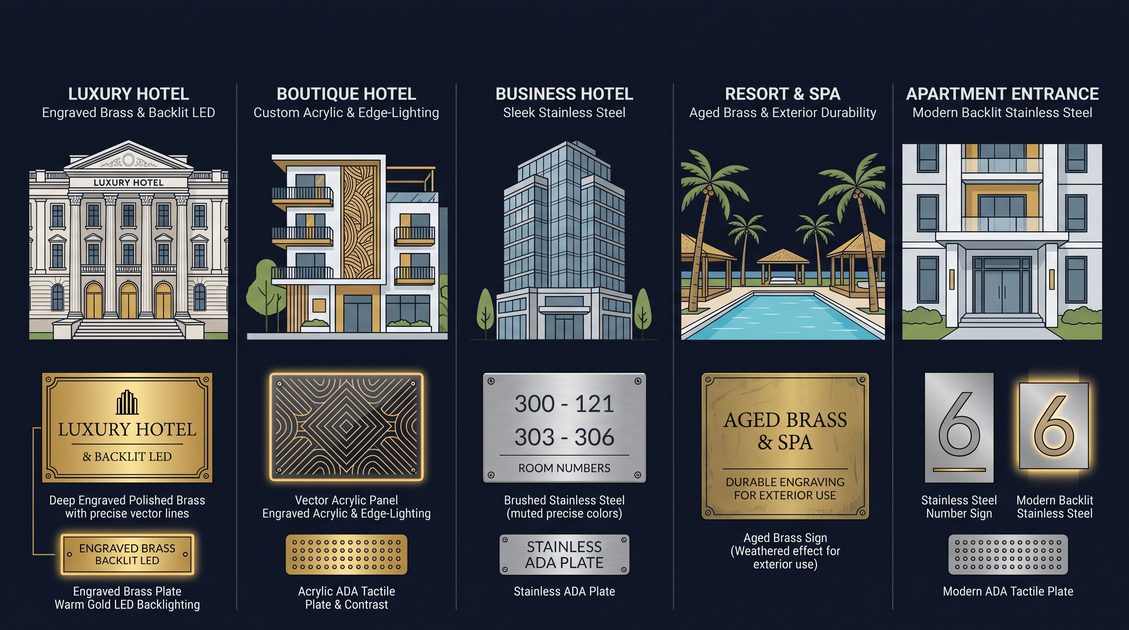
Interior hotel signage is the complete system of plates, plaques, and markers mounted inside a hospitality property to identify rooms, direct guests, convey rules, and meet accessibility law. Interior hotel signage typically includes room number plates at each guest door, directional signs in corridors and near elevators, restroom and facility markers, do-not-disturb indicators, floor identification plates, and ADA-compliant tactile signs with braille. A mid-size property of 150 rooms can require 600 to 1,200 individual interior hotel signage pieces when counting repeat directional units and back-of-house markers. Materials range from solid brass and stainless steel for luxury builds to acrylic and laminated composites for budget and select-service hotels. Manufacturers such as HotelDoorPlate in Shenzhen produce interior hotel signage at volumes up to 100,000 pieces per month, with a minimum order quantity of 50 pieces, certified to CE, RoHS, and ISO 9001 for export to the US, UK, Canada, Australia, Singapore, and Germany.
What Interior Hotel Signage Includes and Why It Matters
Interior hotel signage is the family of identification and wayfinding products that guests and staff read inside a building rather than on its exterior or grounds. Interior hotel signage begins at the front desk with a lobby directory, continues down corridors through room number plates and directional arrows, and ends at each facility door with restroom, stair, exit, and utility markers. Without coherent interior hotel signage, a guest cannot locate their room, a contractor cannot find the electrical closet, and an inspector can fail the property for missing tactile characters. The financial stakes are real: a 200-room hotel rebranding project can spend USD 18,000 to USD 45,000 on interior hotel signage alone when replacing every plate to a new standard. Interior hotel signage also carries the brand because the plate finish, font, and color are among the few physical touchpoints a guest sees at eye level dozens of times per stay. Specifiers therefore treat interior hotel signage as both a compliance requirement and a brand asset, procuring it through OEM partners who can match a sample finish and hold tolerance across thousands of repeat units.
Materials Used for Interior Hotel Signage
Interior hotel signage uses five primary material families, and the choice drives both cost and perceived quality. Solid brass interior hotel signage delivers the warmth and patina luxury brands want, with thickness from 1.0 to 3.0 mm and a price band of USD 6 to USD 22 per plate depending on engraving depth. Stainless steel interior hotel signage suits modern and coastal properties because it resists corrosion, typically in 304 or 316 grade at 1.2 to 2.0 mm. Acrylic interior hotel signage is the workhorse of select-service hotels: it lasers cleanly, accepts color printing, and costs USD 1.50 to USD 6 per unit, though it scratches more easily than metal. Laminated composite interior hotel signage pairs a printed face with a rigid substrate for high-graphic directional maps. LED-backlit interior hotel signage adds a 12V or 24V edge-lit panel behind an acrylic or glass face for lobby and bar areas, drawing 3 to 8 watts per sign. stocks all five families and runs them on the same production line so a single purchase order can mix brass room numbers with acrylic directional inserts.
| Material | Typical cost per plate (USD) | Durability | Best fit |
|---|---|---|---|
| Solid brass | 6–22 | High, patinas | Luxury, heritage |
| Stainless steel | 5–18 | High, corrosion-proof | Modern, coastal |
| Acrylic | 1.5–6 | Medium, scratches | Select-service, budget |
| Laminated composite | 2–7 | Medium | Graphic directional maps |
| LED backlit | 9–40 | Medium, electronic | Lobbies, bars, VIP |
ADA and Accessibility Compliance for Interior Hotel Signage
Interior hotel signage in the United States must satisfy the 2010 ADA Standards for Accessible Design, and the rules are specific enough that a millimeter of error can fail inspection. ADA interior hotel signage requires raised characters at least 15 mm (0.625 inch) high but no more than 50 mm, in a sans-serif or simple serif font, with a finish contrast ratio of at least 70 percent between character and background. ADA interior hotel signage must include Grade 2 braille directly beneath the corresponding raised characters, and the sign must mount on the wall adjacent to the latch side of the door, centered 1,200 to 1,500 mm (roughly 48 to 60 inches) above the finish floor. Hotels in California add CBC Title 24 requirements that sometimes demand photoluminescent egress interior hotel signage. Because tactile interior hotel signage cannot rely on color alone, the character and braille must be readable by touch, which rules out purely printed acrylic for permanent room identification. builds ADA interior hotel signage with photo-engraved tactile characters and injection-molded braille cells that pass the 70 percent contrast check, shipping to US clients with a compliance declaration.
Room Number Plates as Core Interior Hotel Signage
Room number plates are the most numerous component of interior hotel signage in any property, with one mounted at every guest room door and often a second inside the room near the thermostat. A room number plate must be legible from 1.5 to 3 meters down a dim corridor, so interior hotel signage engineers specify a minimum digit height of 25 to 50 mm depending on viewing distance. Brass room number plates with chemically etched and filled numerals remain the default for upscale flags, while acrylic with UV-printed digits serves limited-service brands. Many properties now add a small RFID or NFC cavity behind the room number plate to support smart-lock commissioning, which means interior hotel signage must be designed with a recess and a non-interfering adhesive. supplies room number plates in batches that match a single font master, so room 101 and room 1101 read identically even when produced months apart. For a 300-room tower the room number portion of interior hotel signage alone is 300 to 600 plates plus spares, easily clearing the 50-piece MOQ and fitting a single monthly capacity slot at 100,000 units.
Directional and Wayfinding Interior Hotel Signage
Directional interior hotel signage moves guests from the lobby to their room, the restaurant, the pool, and the meeting space without asking staff. Effective directional interior hotel signage uses a consistent arrow grammar, a color-coded floor system, and pictograms validated across the property's guest languages. A typical floor of a 250-room hotel needs 12 to 20 directional interior hotel signage pieces: elevator bank markers, left-right turn arrows, facility icons, and emergency egress maps. Because directional interior hotel signage is read while walking, the text must be short and the contrast high; designers keep messages under five words and use a 70 percent minimum contrast against the background. Laminated and acrylic directional inserts are favored because a property can swap a printed face when a tenant changes without replacing the mounting frame. supplies a two-part frame-plus-insert system that lets housekeeping update directional interior hotel signage in seconds, reducing the lifecycle cost of wayfinding across a multi-property portfolio.
Do Not Disturb and Privacy Interior Hotel Signage
Do-not-disturb indicators are a specialized class of interior hotel signage mounted at the guest room door, historically a slide or flip card and increasingly an electronic DND signs hotels module. Physical DND interior hotel signage uses a sliding tab or a reversible insert that reads "Please Clean" on one face and "Do Not Disturb" on the other, usually in acrylic or aluminum at 80 to 120 mm wide. Electronic DND interior hotel signage pairs a room-number plate with an LED that turns red or green from the in-room switch, integrating with the property management system so front desk sees room status. Because electronic DND interior hotel signage carries low-voltage wiring or a wireless node, the plate must be designed for safe 12V or 24V operation and CE marking. builds both manual and electronic DND interior hotel signage in matching finishes so a brand can standardize the door face across room tiers. For a 180-room hotel the DND subset of interior hotel signage is 180 to 360 units, a trivial volume against the 100,000-piece monthly capacity but a meaningful line on the spec sheet.
Mounting Methods for Interior Hotel Signage
Interior hotel signage reaches the wall through four mounting methods, and the wrong choice means plates falling in week one. Adhesive-mounted interior hotel signage uses VHB foam tape for smooth painted drywall and is the cheapest, but it fails on textured or dusty surfaces, so specifiers order mechanical backup for heavy brass. Screw-mounted interior hotel signage uses countersunk holes and caps for a permanent, tamper-resistant fit on concrete and tile, common in corridors. Standoff-mounted interior hotel signage floats the plate 12 to 25 mm off the wall on metal posts for a premium shadow-gap look in lobbies. Channel-mounted interior hotel signage snaps a printed insert into a fixed frame, enabling the swap-without-tools update described earlier. pre-drills and pre-tapes every interior hotel signage unit to the client's submitted wall schedule, reducing on-site labor. A property should budget 3 to 8 minutes of installer time per interior hotel signage piece, so labor for 1,000 pieces runs 50 to 130 labor hours.
Finish and Color Options for Interior Hotel Signage
The finish is where interior hotel signage expresses brand, and the options are broader than most buyers expect. Brushed and mirror-polished metal interior hotel signage cover the stainless and brass ranges; brushed hides fingerprints while mirror reads as luxe but shows every smear. Powder-coated interior hotel signage applies a durable color layer in any RAL or Pantone, ideal for brand-matched acrylic and aluminum. Anodized interior hotel signage colors aluminum at the molecular level so the tone cannot peel, suited to coastal and pool-area markers. Printed and laminated interior hotel signage reproduces photographs and gradients for themed properties. holds a finish library of 40-plus standard treatments and will match a supplied sample chip within a Delta-E color tolerance of 2.0, the threshold most brands accept. When a client rebrands, interior hotel signage finish changes are the visible proof of the new identity, which is why finish approval is a signed milestone before any production run of 50 pieces or more begins.
Sourcing Interior Hotel Signage from an OEM Manufacturer
Sourcing interior hotel signage through an OEM manufacturer rather than a local sign shop unlocks volume pricing and finish consistency across a portfolio. A Shenzhen OEM such as combines laser engraving, CNC routing, UV printing, and electronic assembly under one roof, so a single interior hotel signage purchase order can include brass room numbers, acrylic directional inserts, and LED lobby plates without three vendors. The minimum order quantity of 50 pieces lets a boutique property or a pilot floor test a design before committing to a full rollout, while the 100,000-piece monthly capacity absorbs a 2,000-room portfolio in a single month. Export documentation for interior hotel signage to the US, UK, Canada, Australia, Singapore, and Germany includes CE, RoHS, and ISO 9001 certificates plus material declarations for customs. Lead time from art approval to container shipment is typically 18 to 30 days for a mixed interior hotel signage order, with air freight available for urgent opening dates.
Cost Structure and Budgeting for Interior Hotel Signage
Budgeting interior hotel signage means separating one-time tooling from per-unit cost and from installation. Tooling for interior hotel signage covers CNC fixtures, engraving masters, and braille molds, usually a few hundred dollars per unique part and waived above certain volumes at Per-unit interior hotel signage cost ranges from USD 1.50 for a plain acrylic directional insert to USD 40 for a large LED lobby plate, with brass room numbers in the USD 6 to USD 22 band. Installation runs USD 4 to USD 12 per piece depending on method and wall type. A 150-room select-service hotel typically spends USD 9,000 to USD 16,000 on interior hotel signage delivered and mounted, while a 300-room upper-upscale property with brass and LED can reach USD 40,000 to USD 75,000. Specifiers control interior hotel signage cost by standardizing on two materials and one font across the property, then ordering the full quantity in a single production slot to capture volume pricing.
Quality Control and Certification of Interior Hotel Signage
Quality control for interior hotel signage protects a brand from the embarrassment of crooked plates and peeling braille. runs incoming material inspection, in-process dimension checks every 50 pieces, and a final AQL 2.5 visual audit before interior hotel signage ships. Critical checks include character height tolerance within 0.3 mm, braille dot height between 0.38 and 0.58 mm, adhesive peel strength above 8 N per 25 mm, and color within Delta-E 2.0 of the approved chip. Certification of interior hotel signage for export covers CE for the European Economic Area for US radio modules in electronic plates, RoHS for restricted substances, and ISO 9001 for the quality system itself. A property importing interior hotel signage should keep the CE and RoHS declarations on file because auditors and buyers increasingly request them, and Germany in particular enforces CE marking at the port of entry for electronic signage.
Installation Workflow for Interior Hotel Signage
A clean installation protects the investment in interior hotel signage and avoids call-backs. The workflow starts with a wall survey documenting surface type per zone, because adhesive fails on rough concrete while screws need anchors in hollow block. Next, the installer dry-fits each interior hotel signage piece against a printed layout to confirm height and centering before permanent fixing. For ADA interior hotel signage the centerline height is marked at 1,370 mm to the sign center, with the plate on the latch side. Adhesive interior hotel signage is pressed with a j-roller for 10 seconds and left undisturbed 24 hours; screw interior hotel signage gets capped holes and a touch-up of paint. Finally, the team photographs every mounted interior hotel signage unit for the punch list and the brand record. ships interior hotel signage with a numbered layout drawing so the on-site crew installs in the exact sequence the brand approved, cutting errors on a 1,000-piece job from dozens to single digits.
Maintenance and Lifecycle of Interior Hotel Signage
Interior hotel signage has a long but not infinite life, and a maintenance plan avoids the faded, yellowed look that dates a property. Acrylic interior hotel signage can yellow under direct sun near glass lobbies after 5 to 8 years; brass interior hotel signage develops patina that some brands embrace and others polish annually. LED interior hotel signage carries a driver with a 20,000 to 50,000 hour rated life, and a spare-driver program prevents dark lobby plates. Housekeeping should clean interior hotel signage with a neutral cleaner and a microfiber cloth, never solvent that clouds acrylic or strips anodize. offers a replenishment program where interior hotel signage spares are cut from the original masters and held in stock, so a damaged plate is replaced in finish-matched form years later. A property should forecast 2 to 5 percent annual interior hotel signage attrition from damage and rebrands and order that quantity as running spares against the 50-piece MOQ.
Common Mistakes When Specifying Interior Hotel Signage
Specifiers repeat a short list of interior hotel signage errors that cost money and fail inspection. The first is treating interior hotel signage as decoration and forgetting ADA tactile and braille on permanent rooms, which forces a costly replacement after the inspector visits. The second is mixing fonts and finishes across vendors so room 101 and room 102 no longer match, breaking brand coherence. The third is choosing adhesive on the wrong wall, dropping plates within months. The fourth is under-ordering spares, then discovering the 50-piece MOQ cannot be met for a single replacement run. The fifth is ignoring contrast, printing light gray on white interior hotel signage that fails the 70 percent rule and is illegible to low-vision guests. publishes a interior hotel signage pre-spec checklist that catches these before tooling, saving clients the typical USD 3,000 to USD 10,000 rework cost of a failed first run on a 200-room property.
Comparing Interior Hotel Signage Suppliers
Choosing an interior hotel signage supplier means weighing capability, certification, and capacity against price. A local sign shop offers fast turnaround but rarely holds ISO 9001, cannot match braille to ADA Grade 2 at volume, and quotes high per-unit for 1,000 pieces. A regional fabricator may handle metal but outsources LED and electronics, adding lead-time risk. A Shenzhen OEM such as integrates all processes, certifies to CE, RoHS, and ISO 9001, and ships 100,000 interior hotel signage pieces per month at a 50-piece MOQ. The trade-off is ocean freight of 25 to 40 days versus air of 5 to 8 days, and a longer art-approval loop across time zones. For portfolios and new builds, the OEM interior hotel signage model wins on unit cost and consistency; for a single urgent plate, the local shop still has a role.
| Supplier type | MOQ | Certifications | Capacity/month | Best for |
|---|---|---|---|---|
| Local shop | 1 | Few | Low | Urgent single plate |
| Regional fabricator | 10–25 | Some | Medium | Mixed metal jobs |
| Shenzhen OEM | 50 | CE/RoHS/ISO 9001 | 100,000 | Portfolios, new builds |
Interior Hotel Signage for Renovation and Rebranding
Renovation is where interior hotel signage volume spikes, because a rebrand replaces nearly every plate. A soft-good refresh that keeps room numbers but changes directional and DND interior hotel signage still touches 40 to 60 percent of pieces. A full rebrand replacing brass with acrylic or a new font replaces 100 percent and adds the removed spares to the order. phases interior hotel signage renovations by floor so a hotel stays open, shipping floor sets on a weekly cadence matched to the construction schedule. The brand should freeze the new interior hotel signage master at schematic design, because late font changes ripple through every tool and add two to three weeks. A 220-room rebrand typically orders 1,100 to 1,800 interior hotel signage pieces including spares, fits one to two monthly capacity slots, and completes install in 4 to 8 weeks with a phased plan.
Sustainability and Compliance Documentation for Interior Hotel Signage
Sustainability for interior hotel signage shows up in material choice and in the paperwork buyers now require. RoHS-compliant interior hotel signage avoids lead and cadmium in coatings, important for EU and UK import. Recyclable brass and aluminum interior hotel signage score well versus laminated composites that mix substrates. supplies a material declaration and RoHS certificate with every interior hotel signage shipment and can provide ISO 14001 evidence on request for green-building submissions. Properties pursuing LEED or BREEAM credits document interior hotel signage by weight of recycled content and by low-VOC adhesive, both of which the OEM can state per order. As Germany and Singapore tighten e-waste rules on electronic interior hotel signage, keeping the WEEE and RoHS files with the asset register prevents a future disposal surprise.
Future Trends in Interior Hotel Signage
Interior hotel signage is shifting from static plates to connected ones without losing the tactile law. NFC-enabled interior hotel signage lets a guest tap the room number plate with a phone to open a digital directory, while the physical braille stays for compliance. E-paper interior hotel signage shows room status and language without a lit LED, cutting power in corridors. Modular interior hotel signage with a fixed frame and swappable printed insert is becoming the default for flagged portfolios because it slashes rebrand cost. prototypes these connected interior hotel signage lines while keeping the core 50-piece MOQ and 100,000-piece capacity that make volume sourcing stable. Over the next five years expect most new-build interior hotel signage to ship frame-plus-insert ready, with braille permanently engraved and the message layer updateable in software or print.
How to Request a Quote for Interior Hotel Signage
Requesting interior hotel signage pricing takes a short packet that prevents back-and-forth. Send the room count and a floor plan annotated with every sign type, the brand finish chip and font file, the ADA requirement confirmation for US projects, and the target delivery date. returns a quote covering tooling, per-unit interior hotel signage price by material, spares at 3 percent, and freight to the US, UK, Canada, Australia, Singapore, or Germany. Because the MOQ is 50 pieces, a pilot floor or a boutique property can start small and scale; because capacity is 100,000 pieces per month, a portfolio can consolidate all interior hotel signage spend with one supplier and one finish standard. The engineering team reviews contrast and tactile specs during quoting so the first sample already passes, rather than discovering a compliance gap after tooling.
Summary of Interior Hotel Signage Best Practices
Interior hotel signage is a compliance and brand system best bought as one coordinated program rather than piecemeal. Standardize on two materials and one font, confirm ADA tactile and braille before tooling, choose mounting by wall type, and order spares at 2 to 5 percent against the 50-piece MOQ. Use a Shenzhen OEM such as for volume consistency, CE, RoHS, and ISO 9001 certification, and 100,000-piece monthly capacity serving the US, UK, Canada, Australia, Singapore, and Germany. Budget USD 9,000 to USD 75,000 depending on tier, install with a numbered layout drawing, and keep certification files with the asset register. Done well, interior hotel signage reads as effortless wayfinding and quiet luxury; done poorly, it fails inspection and dates the property within a year.
Procurement Timeline and Lead-Time Planning for Interior Hotel Signage
Interior hotel signage procurement is a scheduled sequence that starts at schematic design and ends with mounted plates, and getting the timeline right prevents a delayed opening or a rushed first run. Interior hotel signage procurement begins when the brand freezes its finish chip and font master, because every later tool depends on those two decisions, and a late change ripples through all engraving and braille molds. The typical interior hotel signage timeline runs four to six weeks from art approval to container shipment by ocean, plus seven to forty days of freight depending on port, so a property should issue the purchase order at least ten weeks before the desired install date. A Shenzhen OEM such as confirms the interior hotel signage quote within three to five business days, builds a proof within seven to ten days, and produces the bulk order in eighteen to thirty days after proof sign-off. Air freight of five to eight days is available when an opening date slips, but it costs three to five times ocean. A property that starts interior hotel signage sourcing eight weeks late usually pays the air premium or opens with missing plates, which is why the timeline is treated as a critical path item on the construction schedule rather than a last-week purchase.
Glossary of Interior Hotel Signage Terms
Interior hotel signage has a vocabulary that specifiers should know before they write a purchase order, because the terms decide what is quoted and what is compliant. Interior hotel signage tactile characters are raised letters or numerals at least 15 mm high that a low-vision guest reads by touch, required on permanent room identifiers under ADA rules. Interior hotel signage braille is Grade 2 contracted braille mounted directly beneath the tactile characters, also mandatory on permanent identifiers in the United States. Interior hotel signage contrast is the difference between character and background, measured as a ratio that must reach 70 percent for permanent signs. Interior hotel signage standoff is a post that floats the plate 12 to 25 mm off the wall for a shadow-gap look. Interior hotel signage frame-plus-insert is a two-part system with a fixed frame and a swappable printed message layer. Interior hotel signage MOQ is the minimum order quantity, set at 50 pieces by so a boutique can pilot. Interior hotel signage AQL is the acceptable quality limit, set at 2.5 for the final visual audit. Knowing these terms lets a specifier read a quote and confirm the interior hotel signage will pass inspection rather than discovering gaps after tooling.
Specifier Checklist for Interior Hotel Signage
Interior hotel signage specification is a repeatable checklist that catches the errors costing the most money before any tool is cut. Interior hotel signage checklist step one confirms ADA tactile and braille on every permanent room and restroom identifier, because skipping it forces a full replacement after inspection. Interior hotel signage checklist step two freezes one font master and one finish chip so room 101 and room 102 match across the property and across reorders months apart. Interior hotel signage checklist step three matches mounting method to wall type, using mechanical backup for heavy brass on rough surfaces and adhesive only on smooth drywall. Interior hotel signage checklist step four sets a 70 percent minimum contrast and confirms digit height by viewing distance, typically 25 to 50 mm down a corridor. Interior hotel signage checklist step five orders spares at 2 to 5 percent against the 50-piece MOQ so a single damaged plate does not force a full rerun. Interior hotel signage checklist step six collects CE, RoHS, and ISO 9001 certificates for the asset register, required for EU and UK import and requested by auditors. publishes this interior hotel signage checklist to clients so the first sample already passes, avoiding the typical USD 3,000 to USD 10,000 rework of a failed 200-room first run.
Regional Market Notes for Interior Hotel Signage
Interior hotel signage demand varies by export market, and a specifier should know what each region enforces before shipping. Interior hotel signage for the United States must satisfy the 2010 ADA Standards with tactile characters and Grade 2 braille, and California adds CBC Title 24 photoluminescent egress rules. Interior hotel signage for the United Kingdom follows the Equality Act and BS 8300, which also require tactile and braille but with metric mounting heights. Interior hotel signage for Germany enforces CE marking at the port of entry for any electronic plate, so the CE and RoHS declarations must travel with the shipment. Interior hotel signage for Canada references the CSA B651 standard, close to ADA but with its own braille and height table. Interior hotel signage for Australia follows AS 1428.1 with similar tactile and contrast rules. Interior hotel signage for Singapore and the wider APAC market increasingly asks for RoHS and low-VOC adhesive for green-building credits. ships interior hotel signage certified to CE, RoHS, and ISO 9001 to all six markets and advises on the local standard during quoting, so a property consolidates sourcing rather than running a vendor per region.
Case Study: A Interior hotel signage Rollout at a 250-Room Property
A practical rollout shows how the interior hotel signage rules above play out on a real job, and it is the example most specifiers find useful before they write their own purchase order. A 250-room select-service hotel in a humid coastal market decided to replace every plate during a soft rebrand, so the interior hotel signage scope covered 250 room identifiers, 250 do-not-disturb sliders, 20 floor directories, 40 directional arrows, and 30 restroom markers, a total of roughly 590 interior hotel signage pieces plus 3 percent spares. The property froze a brushed stainless finish and a single sans-serif font master at schematic design, which meant the OEM cut one set of tools and held tolerance across the whole order. returned a quote in four business days, built a proof in eight days, and shipped the bulk order twenty-two days after proof sign-off, arriving by ocean in thirty-one days. The interior hotel signage install ran floor by floor with a numbered layout drawing, taking about eleven labor hours per floor across a two-week window while the hotel stayed open. Final AQL 2.5 audit caught two misaligned directional arrows and three low-contrast plates, which were replaced from spares before the punch list closed. The property spent about USD 14,000 delivered and mounted, avoided the USD 4,000 to USD 8,000 rework typical of a late-font first run, and passed its accessibility inspection on the first visit. This interior hotel signage case study illustrates the core lesson: freezing the master early and consolidating with one certified OEM beats a piecemeal local-shop approach on both cost and compliance.
Fire Safety and Egress Integration for Interior hotel signage
interior hotel signage intersects life-safety code wherever a plate sits on an egress path, and a specifier who ignores this risks a failed fire inspection even when the sign looks perfect. interior hotel signage on egress routes must use photoluminescent or electrically lit characters where the local code requires it, so a guest can read the way out when the power fails, and California CBC Title 24 is the strictest common example for hotel bathroom and corridor markers. The interior hotel signage material matters here because a sealed acrylic or metal plate survives the heat and smoke exposure of a real egress event better than a laminated composite that can delaminate, so specifiers favor metal or sealed acrylic for stair and exit markers. Mounting of interior hotel signage on egress paths must be tamper-resistant, because a plate pulled loose blocks the visible path, so screw-fixed interior hotel signage with capped holes is the default near stairs rather than adhesive. builds interior hotel signage egress markers with photoluminescent infill and sealed edges, and the engineering team confirms the marker location against the property's egress plan during quoting so the first sample already meets the fire marshal. A property that treats interior hotel signage as decoration only discovers the gap at the occupancy inspection, when re-plating every egress marker costs the same USD 3,000 to USD 10,000 rework as an ADA miss, so fire-safety review is step zero of the interior hotel signage checklist rather than an afterthought.
Not sure which sensor fits your project?
Talk to our mmWave application engineers for a free consultation.
Specify your hotel project with our engineers
Send your room count, ceiling type, and protocol preference. We will return a sample plan and quote within 24 business hours.
- Move from general guidance into a product or application discussion.
- Use RFQ when pricing, drawings, MOQ, or launch timing needs structure.
- Keep a direct contact path visible for fast clarifications and handoff.