Laundry Room Signs for Hotels and Apartments
Laundry room signs identify shared washers, dryers, and rules with durable ADA plates for hotels and apartments, materials, mounting, MOQ 50, sourcing.
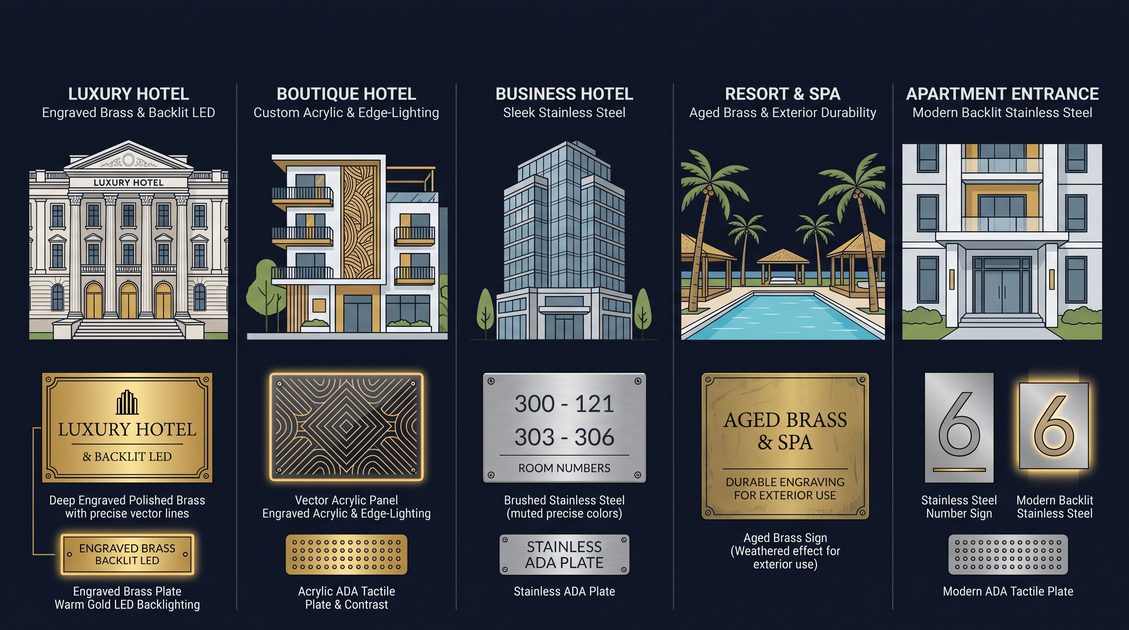
Laundry room signs are the plates and labels mounted at a shared washing facility that identify washers, dryers, folding areas, and posted rules for guests or residents. A standard laundry room signs unit measures 100 by 200 mm to 150 by 250 mm and carries a pictogram or word such as "LAUNDRY", "WASHERS", "DRYERS", or "IRONING", in brass, stainless steel, aluminum, or acrylic. In hotels and apartment buildings the laundry room signs prevent confusion in a high-moisture, high-traffic space where a missing label sends residents to the wrong machine. Cost for standard engraved laundry room signs runs USD 6 to USD 22 at MOQ 50 pieces, while LED or illuminated versions reach USD 18 to USD 50. A manufacturer with CE, RoHS, and ISO 9001 certification and 100,000 pieces per month capacity can supply a property group from a Shenzhen base, serving the US, UK, Canada, Australia, Singapore, and Germany where shared laundry is standard in apartments and extended-stay hotels.
Why laundry room signs reduce complaints
Laundry room signs reduce complaints because a shared wash facility is one of the most disputed spaces in a building, and clear labels settle most arguments before they start. A laundry room signs that names each machine and posts the rules cuts the "whose load is this" and "why is the dryer hot" friction that fills a manager's inbox. In a hotel the laundry room signs tells guests where to find washers without asking staff, reducing front-desk calls during peak hours. In an apartment the laundry room signs posts hours, card rules, and cleanup duty, which lowers mess and machine abuse. The space is uniquely harsh on signage: humidity from dryers, detergent splashes, and constant contact mean a paper sign fails in days, so a durable laundry room signs in metal or sealed acrylic survives five to ten years. From a brand view the laundry room signs is a small but visible touchpoint that signals a maintained building. Specifying laundry room signs correctly at fit-out protects the investment and avoids the cost of replacing waterlogged, peeled labels after a few months of guest or resident use.
Types of laundry room signs
Types of laundry room signs split into facility-name plates, machine labels, rules plates, and status indicators, each with a different job. A facility-name laundry room signs reads "LAUNDRY ROOM" at the door. A machine-label laundry room signs names "WASHER 1" or "DRYER 2" so residents pick the right unit. A rules laundry room signs posts hours and conduct. A status laundry room signs adds an "IN USE" or "OUT OF ORDER" slide or LED. The table lists the common signs and the field each carries, because a mixed set across a room must read as one system rather than a patchwork.
| Sign type | Fields | Mount location |
|---|---|---|
| Facility name | Word, pictogram | Door |
| Machine label | Number, type | Above unit |
| Rules | Text block | Wall |
| Status | In use/out | Unit or door |
ADA compliance for laundry room signs
ADA compliance for laundry room signs in the United States follows the 2010 ADA Standards for Accessible Design, which require permanent rooms to display signs with raised characters and Grade 2 Braille. A compliant laundry room signs uses uppercase sans-serif raised characters at least 15 mm (5/8 inch) tall with a minimum 0.8 mm raise, a non-glare finish, and contrast of at least 70 percent. The pictograms sit in a 150 mm minimum clear field, and the sign mounts on the wall adjacent to the door latch side, centered 1400 to 1700 mm above the floor, never on the door itself. International equivalents broaden the duty: the UK Equality Act 2010 with BS 8300, the EU EN 301 549, and Australia's Disability (Access to Premises) standard each mandate tactile, high-contrast plates for permanent rooms. For laundry room signs that ship to the US, UK, Canada, Australia, Singapore, and Germany, adopt the strictest common baseline of raised tactile characters, Braille, non-glare matte surfaces, and wall-adjacent mounting. A supplier compliance declaration referencing the applicable standard is essential paperwork for the file and any future audit of the building.
Materials for laundry room signs
The materials for laundry room signs are stainless steel, aluminum, and acrylic, chosen for moisture resistance and cost since the room is steamy. Stainless steel laundry room signs resist humidity, detergent, and heat better than any alternative and reads as clean and modern. Aluminum laundry room signs keep weight and price down for large apartment groups while allowing anodized color. Acrylic laundry room signs enable full-color print and LED backlight, useful for status glow in a dim room. The table compares the three substrates across factors relevant to a laundry, weighting humidity resistance since the space is uniquely harsh on signage.
| Material | Per-unit cost (MOQ 50) | Humidity resistance | Best finish | Typical use |
|---|---|---|---|---|
| Stainless steel | USD 12 to 22 | Excellent | Brushed, mirrored | Shared, hotel |
| Aluminum | USD 6 to 14 | Good | Anodized, etched | Apartment groups |
| Acrylic | USD 8 to 18 | Good (sealed) | Printed, backlit | LED status |
Mounting laundry room signs
Mounting laundry room signs follows adhesive, standoff, or concealed-screw methods chosen for the wall and unit. Adhesive laundry room signs use high-bond tape and install fast on smooth tile or painted walls, good for a live building. Standoff laundry room signs float 10 to 15 mm off the wall on posts for a premium look. Concealed-screw laundry room signs resist tampering in public facilities. Because the laundry room signs sits in steam, the adhesive must be rated for humidity and the plate must seal at the edges so moisture does not wick behind it. The table contrasts the three mounts by install speed, security, and rework cost, since the room gets re-themed and the mount should survive a plate swap without patching the wall.
| Mount | Install speed | Tamper resistance | Rework cost |
|---|---|---|---|
| Adhesive | Fast | Low | Low |
| Standoff | Medium | Medium | Medium |
| Concealed screw | Slow | High | High |
Cost of laundry room signs
The cost of laundry room signs divides into design and tooling, substrate and decoration, electronics for LED units, hardware and mounting, and freight. Design and tooling usually run USD 80 to USD 250 for a custom rules template, often waived above a 500-piece order. Substrate and decoration are the largest recurring line: stainless engraved plates cost USD 12 to USD 22 each, aluminum USD 6 to USD 14, and acrylic USD 8 to USD 18 at MOQ 50, with per-unit price dropping 15 to 30 percent above 1,000 units. LED electronics add USD 6 to USD 30 depending on display type. Mounting hardware costs USD 0.30 to USD 2.00 per plate. Sea freight from Shenzhen to the US west coast adds about USD 0.40 to USD 1.20 per kilogram. A realistic 40-plate stainless laundry room signs program for a building lands near USD 500 to USD 1,000 all-in, while a 150-plate acrylic LED program ranges USD 1,500 to USD 4,000. Budget 5 to 10 percent extra for spare plates covering damage and renames across the property.
MOQ and capacity for laundry room signs
Minimum order quantity and production capacity shape how a laundry room signs program is phased across a property or portfolio. A standard MOQ of 50 pieces fits a single-building pilot or a boutique apart-hotel, letting facilities validate material and ADA detail before a portfolio-wide commitment. With monthly capacity of 100,000 pieces, a supplier can absorb a 10,000-plate multi-site deployment in one production month while serving other clients, which matters when several buildings renovate on overlapping schedules. Lead time splits into sampling (7 to 10 days for proof plates) and mass production (20 to 30 days for engraving, anodizing, and QA). For laundry room signs with integrated LED, add five to seven days for electronics assembly. Procurement should sequence orders so highest-traffic buildings receive plates first, then back-of-house. Because room names shift during fit-out, negotiate a 10 to 15 percent over-run of blank or easily re-engraved plates; acrylic and aluminum accept re-work more readily than lacquered brass. Confirm the supplier can retain your artwork and Braille translation on file so later reorders stay identical to the original laundry room signs release across years and phases of expansion.
Quality and inspection for laundry room signs
Quality and inspection for laundry room signs protect a building from faded, misaligned, or non-compliant plates that surface after install. A receiving inspection samples 5 to 10 percent of a laundry room signs shipment and verifies character height, raise depth, contrast, Braille accuracy, and mount flatness against the approved proof. A rub test with a dry cloth confirms the finish will not smear under daily cleaning, and a contrast meter confirms the 70 percent minimum. Photograph each approved proof plate and keep it on file so a reorder matches the original. Ask the supplier for a certificate of compliance referencing the applicable standard and for material mill certificates where stainless or aluminum is specified. For LED laundry room signs, a 48-hour burn-in before shipment catches early failures cheaply. Tracking lot numbers lets a defect be traced to a production run, and a 10 to 15 percent spare plate reserve means a failed or damaged laundry room signs unit can be swapped without delaying opening or waiting on a new minimum order.
Sourcing laundry room signs from a manufacturer
Sourcing laundry room signs from a manufacturer begins with a brief: quantity per design, substrate, finish, mounting, ADA or local standard, and target market. A Shenzhen maker such as HotelDoorPlate quotes from the brief, supplies proof plates in 7 to 10 days, and holds artwork on file for reorders across years. Expect CE, RoHS, and ISO 9001 certificates in the package, since these back export to the US, UK, Canada, Australia, Singapore, and Germany. Confirm the MOQ of 50 pieces and the 100,000-piece monthly capacity so your rollout timing is safe, and confirm lead time of 20 to 30 days for mass production plus 5 to 7 days for LED assembly. Payment usually runs T/T 30 percent deposit with 70 percent before shipment, with L/C at sight and Trade Assurance as alternates. Shipping terms of FOB Shenzhen, CIF, DDP, or EXW let you choose who clears customs. Because laundry room signs are a recurring reorder item as properties rebrand, pick a supplier that retains your Braille translation and font so a 50-piece top-up years later matches the original building exactly.
Comparison of laundry room signs by property tier
laundry room signs vary by property tier in material, finish, and electronics, and matching the plate to the tier prevents overspend at the budget end and under-delivery at the luxury end. An economy laundry room signs program uses aluminum or acrylic plates with simple engraving, keeping per-unit cost near USD 6 to USD 14 while still meeting the tactile and contrast rules that apply to every permanent room. A midscale laundry room signs program upgrades to brushed stainless at USD 12 to USD 25, which reads as crisp and modern and survives the higher corridor traffic of a limited-service property. An upscale laundry room signs program uses brass or mirrored stainless with a standoff mount and sometimes LED edge light, costing USD 20 to USD 80 per plate but signaling the premium the rate commands. The table compares the tiers by substrate, per-unit cost, and the impression each leaves on a guest, because a mismatch is visible the moment a guest steps onto the floor and reads the door.
| Tier | Substrate | Per-unit cost | Guest impression |
|---|---|---|---|
| Economy | Aluminum, acrylic | USD 6 to 14 | Functional, clean |
| Midscale | Brushed stainless | USD 12 to 25 | Modern, crisp |
| Upscale | Brass, mirrored | USD 20 to 80 | Premium, intentional |
Common mistakes when specifying laundry room signs
Common mistakes when specifying laundry room signs cost properties money and compliance after the plates are already mounted. The first laundry room signs mistake is placing the plate on the door leaf instead of the latch-side wall, which fails ADA because a moving door leaves the tactile reading zone and a touch reader cannot track it. The second laundry room signs mistake is a glossy finish that creates glare under corridor lights, dropping the effective contrast below the 70 percent minimum even when the ink is dark. The third laundry room signs mistake is skipping the required tactile field on the assumption that the label is obvious, which fails audits in the US, UK, Canada, Australia, Singapore, and Germany. The fourth laundry room signs mistake is ordering exactly the count with no over-run, so a damaged or renamed plate forces a new minimum order and a wall patch. The fifth laundry room signs mistake is mixing fonts between floors during a phased fit-out, which reads as unmanaged. Avoid all five by approving a single proof, retaining artwork on file, and negotiating a 10 to 15 percent spare reserve with the supplier before mass production begins.
Installation timeline for laundry room signs
The installation timeline for laundry room signs splits into sampling, mass production, and on-site fitting, and understanding it prevents a late opening. A laundry room signs order begins with a 7 to 10 day sampling stage where the supplier cuts proof plates from your artwork and ships them for approval; this is the only point where a layout error is cheap to fix. Mass production of laundry room signs then runs 20 to 30 days for engraving, anodizing, and QA, extending to 25 to 37 days if LED modules are assembled and burn-tested. Sea freight from Shenzhen to the US west coast adds 18 to 28 days, or 5 to 8 days by air at higher cost, so a realistic door-to-door laundry room signs timeline is 45 to 75 days by sea. On-site fitting of laundry room signs is fast: adhesive plates install in seconds per door, standoffs in a few minutes, and a 200-room floor can be signed in one to two working days by a two-person crew. Sequence guest-facing areas first so the property can open revenue spaces while back-of-house plates arrive, and keep the 10 to 15 percent spare laundry room signs reserve for damage during the fit-out push.
Maintenance and care for laundry room signs
Maintenance and care for laundry room signs protect the five-to-ten-year life the plates are built for and keep them inspection-ready. A laundry room signs plate in stainless or aluminum needs only a daily wipe with a neutral cleaner; avoid abrasive pads that scratch the matte finish and reduce contrast. Brass laundry room signs need a lacquer touch-up near steam every one to two years to slow tarnish, or the warm tone dulls to patchy brown. Acrylic laundry room signs should be cleaned with a soft cloth and no solvent, because ammonia-based sprays craze the edge light. For LED laundry room signs, a quarterly check of the indicator and a replacement of any unit that flickers keeps the corridor consistent and avoids a guest reporting a dead light. Keep a documented laundry room signs spare reserve of 10 to 15 percent so a damaged plate swaps in minutes without a new minimum order. Photograph the approved proof and store it with the lot number so a reorder matches the original release exactly, which matters when a floor is extended three years after the first laundry room signs install.
Export and customs for laundry room signs
Export and customs for laundry room signs determine the true landed cost and the delivery date a property can promise guests. A laundry room signs shipment from Shenzhen typically moves under FOB, CIF, DDP, or EXW terms, and the choice decides who pays freight and clears customs. Under DDP the supplier handles duties, which simplifies import for a US or German buyer but raises the quote; under FOB the buyer books freight and pays the port, keeping control of the laundry room signs logistics. CE, RoHS, and ISO 9001 certificates travel with the laundry room signs cartons and satisfy the US, UK, Canada, Australia, Singapore, and Germany markets, though the EU and UK may ask for a Declaration of Conformity at the border. Sea freight adds about USD 0.40 to USD 1.20 per kilogram, so a 300-gram stainless laundry room signs plate carries roughly USD 0.12 to USD 0.36 of shipping. Budget for a 2 to 5 percent customs and brokerage buffer on the laundry room signs value, and confirm the HS code with the supplier so the declaration is clean and the container is not held at the port.
Buying checklist for laundry room signs
A buying checklist for laundry room signs turns a vague requirement into a spec a supplier can quote the same day. Start the laundry room signs checklist with quantity per design and the total count, since MOQ is 50 pieces and capacity is 100,000 per month. Next on the laundry room signs checklist is substrate and finish: aluminum for economy, stainless for midscale, brass or mirrored for upscale, acrylic for LED. The laundry room signs checklist then captures mounting (adhesive, standoff, or concealed screw), the target standard (ADA, BS 8300, EN 301 549, or Australia premises), and the export market, because these drive the tactile and Braille detail. Add the laundry room signs checklist item of a 10 to 15 percent spare reserve and the retention of artwork and Braille translation on file for later reorders. Confirm the laundry room signs lead time of 20 to 30 days plus 5 to 7 days for LED, the payment terms (T/T 30 percent deposit, 70 percent before shipment), and the certificates (CE, RoHS, ISO 9001). With this laundry room signs checklist complete, a Shenzhen maker such as HotelDoorPlate returns a firm quote and a proof in 7 to 10 days.
Cost drivers behind laundry room signs
The cost drivers behind laundry room signs are the same five lines on every signage quote, and knowing them lets a buyer challenge a number instead of accepting it. The first laundry room signs cost driver is substrate: acrylic and aluminum sit at the low end, brass and mirrored stainless at the high end, and the gap can be threefold for the same size plate. The second laundry room signs cost driver is decoration method: laser engraving costs less than UV full-color print, and print costs less than an LED module with its driver and wiring. The third laundry room signs cost driver is order volume, because tooling of USD 80 to USD 400 is amortized across the run and per-unit price drops 15 to 30 percent above 1,000 pieces. The fourth laundry room signs cost driver is mounting hardware, where concealed screws and standoffs add labor and parts versus simple adhesive. The fifth laundry room signs cost driver is freight and duty, which add roughly USD 0.40 to USD 1.20 per kilogram by sea plus a 2 to 5 percent customs buffer. A buyer who names these cost drivers can shift the quote by choosing a cheaper substrate or a larger first order rather than by arguing margin.
Sustainability and recycling of laundry room signs
Sustainability and recycling of laundry room signs matter to properties with green-building targets, and the substrate choice drives the score. An aluminum laundry room signs is the strongest circular option because it is infinitely recyclable and the anodized finish needs no plating that complicates recovery. A stainless laundry room signs is also recyclable but heavier, so its transport footprint per plate is higher than aluminum. An acrylic laundry room signs is recyclable only where PMMA streams exist, and an LED laundry room signs adds electronics that need separate e-waste handling at end of life. Specify laundry room signs with a single material where possible, avoid mixed plastic-and-metal bonded parts that defeat sorting, and ask the supplier for material mill certificates to support a LEED or BREEAM submission. A 10 to 15 percent spare laundry room signs reserve also reduces waste, because a damaged plate swaps instead of triggering a full re-order that scraps the unused portion of a minimum run.
Future trends for laundry room signs
Future trends for laundry room signs point toward electronics and data without abandoning the compliant tactile base. The next wave of laundry room signs adds NFC or QR on the plate so a guest taps a phone to request service, while the raised characters and Braille stay for accessibility. A second laundry room signs trend is e-ink status that shows room state without an LED glow, cutting power and reading well in daylight. A third laundry room signs trend is parametric ordering, where a facilities team edits a spreadsheet of names and the supplier cuts plates overnight from retained artwork, shrinking lead time from weeks to days. A fourth laundry room signs trend is regional standardization, as the US, UK, Canada, Australia, Singapore, and Germany converge on clearer tactile baselines that simplify export. Whatever the laundry room signs trend, the plate must keep the tactile field compliant, because no connected feature can replace a touch reader that needs the standard term to navigate the building safely.
Glossary of laundry room signs terms
A glossary of laundry room signs terms helps a non-specialist buyer read a quote without guessing. In laundry room signs work, tactile means raised characters a finger reads, Braille is the Grade 2 contraction beside them, and clear field is the 150 mm minimum pictogram area kept free of competing graphics. A laundry room signs non-glare finish is a matte surface that avoids glare under corridor lights, and contrast is the 70 percent minimum between character and background. Mounting terms for laundry room signs are adhesive (tape), standoff (posts that float the plate), and concealed screw (hidden fixings). LED in laundry room signs means a low-voltage indicator drawing under 2 watts, and burn-in is the 48-hour test that catches early failures. MOQ for laundry room signs is 50 pieces and monthly capacity is 100,000, so even a large rollout fits one production cycle from a Shenzhen base serving the US, UK, Canada, Australia, Singapore, and Germany.
Specifying laundry room signs for a new build
Specifying laundry room signs for a new build starts at the architectural drawing stage, not at fit-out, because the mounting surface and the tactile field location are decided long before a plate is ordered. A new-build laundry room signs spec names the substrate, finish, mounting method, and the applicable standard (ADA, BS 8300, EN 301 549, or Australia premises) in the door schedule so the contractor prepares the right wall adjacent to the latch side. The laundry room signs spec also reserves a 10 to 15 percent spare pool and locks the artwork and Braille translation with the supplier so later phases match the first. For a LED laundry room signs, the new-build spec runs low-voltage conduit during construction rather than retrofitting wire through a finished wall, which cuts install cost and risk. Coordinate the laundry room signs order to the 20 to 30 day production window plus 5 to 7 days for LED and 18 to 28 days of sea freight, so the plates land before the certificate of occupancy walk-through. A Shenzhen maker such as HotelDoorPlate supports this sequence with CE, RoHS, and ISO 9001 certificates and a 100,000-piece monthly capacity that absorbs a full new-build laundry room signs release in one cycle.
Working with a laundry room signs supplier on revisions
Working with a laundry room signs supplier on revisions is smoother when the first proof is treated as the contract for every later plate. A laundry room signs revision after approval usually means a new minimum order and a new tooling fee unless the change is minor and the supplier retains your artwork, so the disciplined buyer freezes the layout before mass production. When a laundry room signs revision is unavoidable, such as a rebrand or a room rename, supply the updated data as a spreadsheet and let the supplier regenerate plates from the retained template, which keeps font, contrast, and tactile profile identical to the original release. Ask the laundry room signs supplier for a revised certificate of compliance if the standard or market changed, and keep the lot number on file so a future audit can trace the plate to its production run. The MOQ of 50 pieces and capacity of 100,000 per month mean even a late laundry room signs revision can ship inside the same quarter, but the lead time of 20 to 30 days plus freight still applies, so plan revisions at phase boundaries rather than mid-occupancy.
Frequently asked questions about laundry room signs
Frequently asked questions about laundry room signs cluster around compliance, cost, and timing, and answering them early prevents a stalled purchase. The most common laundry room signs question is whether a humorous or decorative plate can replace the tactile term; the answer is no, the tactile field must carry the standard word and Braille while the charm sits beside it. The second laundry room signs question is the true minimum order; it is 50 pieces, with price dropping above 1,000. The third laundry room signs question is lead time; it is 20 to 30 days plus 5 to 7 days for LED and 18 to 28 days of sea freight. The fourth laundry room signs question is which markets are served; the US, UK, Canada, Australia, Singapore, and Germany are covered by CE, RoHS, and ISO 9001 certificates. The fifth laundry room signs question is longevity; a well-specified plate lasts five to ten years. With these laundry room signs answers documented, a facilities or procurement lead can approve a purchase order without a follow-up call to legal or the architect.
Regional notes for laundry room signs
Regional notes for laundry room signs matter because the same plate that passes in one market can fail in another if the spec is built to the weakest baseline. In the United States the laundry room signs must meet the 2010 ADA Standards with raised characters at least 15 mm tall and Grade 2 Braille on the latch-side wall. In the United Kingdom the laundry room signs follows the Equality Act 2010 with BS 8300, which similarly requires tactile and high-contrast plates for permanent rooms. In the European Union the laundry room signs must satisfy EN 301 549, and in Australia the Disability (Access to Premises) standard applies. For laundry room signs shipping to Singapore and Germany, adopt the strictest common baseline so a single artwork serves all export markets without a per-country redesign. A supplier compliance declaration referencing the applicable standard is essential paperwork, and the artwork should label which text is tactile versus decorative. Because HotelDoorPlate serves the US, UK, Canada, Australia, Singapore, and Germany from a Shenzhen base, the laundry room signs can be specified once and certified for every destination, which simplifies procurement for a multinational property group.
Sample request template for laundry room signs
A sample request template for laundry room signs saves a buyer from writing the same brief from scratch for every property. The laundry room signs template opens with quantity per design and total count, states the substrate and finish, names the mounting method, and cites the target standard such as ADA, BS 8300, EN 301 549, or the Australia premises rule. The laundry room signs template then lists the export market, the need for CE, RoHS, and ISO 9001 certificates, and the requested proof timeline of 7 to 10 days. Include a line for the 10 to 15 percent spare reserve and for retention of artwork and Braille translation on file, because those two items prevent a costly repeat minimum order later. Close the laundry room signs template with the payment terms (T/T 30 percent deposit, 70 percent before shipment) and the shipping terms (FOB, CIF, DDP, or EXW). A complete laundry room signs template lets a Shenzhen maker such as HotelDoorPlate return a firm quote and a proof without a round of clarifying questions, which compresses the whole purchase from weeks to days.
Summary of laundry room signs best practice
A summary of laundry room signs best practice distills the whole guide into five actions a buyer can take on Monday. First, specify the laundry room signs with the tactile field on the latch-side wall, never on the door, and keep the standard term and Braille in that field while any humor or charm sits beside it. Second, choose the substrate by tier: aluminum or acrylic for economy, stainless for midscale, brass or mirrored for upscale, and acrylic for LED. Third, order a 10 to 15 percent spare laundry room signs reserve and retain artwork and Braille translation on file so later reorders match the first release. Fourth, confirm the supplier holds CE, RoHS, and ISO 9001 certificates and can serve the US, UK, Canada, Australia, Singapore, and Germany from a Shenzhen base with MOQ 50 and 100,000 pieces per month capacity. Fifth, plan the laundry room signs timeline as 20 to 30 days production plus 5 to 7 days for LED and 18 to 28 days of sea freight so the plates land before opening. Following this laundry room signs best practice keeps the corridor compliant, durable, and on budget across the full life of the property.
Not sure which sensor fits your project?
Talk to our mmWave application engineers for a free consultation.
Specify your hotel project with our engineers
Send your room count, ceiling type, and protocol preference. We will return a sample plan and quote within 24 business hours.
- Move from general guidance into a product or application discussion.
- Use RFQ when pricing, drawings, MOQ, or launch timing needs structure.
- Keep a direct contact path visible for fast clarifications and handoff.